Guide: How to Succeed with Pool Care
Remember to begin treating your pool water as soon as you have filled the pool.
Before the Pool Season
Always begin by cleaning the pool thoroughly before the start of the season. This is important because contaminants provide a breeding ground for bacteria and organic growth. Water is left in winter-resistant pools.
Pre-Season Pool Checklist
The pre-season pool checklist can sometimes feel overwhelming, and there is a lot to do before you can take that eagerly awaited first swim.
1. Before Start-Up
- Check the pool cover, pool enclosure, or winter cover for damage.
- Remove leaves, dirt, and debris from the pool area.
- Check the pool structure, liner, and joints for cracks or leaks.
- Clean the waterline and pool edges.
2. Install and Check the Equipment
- Reinstall the ladder, handrails, and any lighting.
- Check that the pump, filter, and heat pump are intact and clean.
- Reinstall plugs, nozzles, and skimmer baskets.
- Check hoses, valves, and connections for leaks.
- Lubricate O-rings and seals as needed.
3. Fill and Circulate the Water
- Fill the pool to the correct water level if needed.
- Start the circulation pump.
- Check that water flows properly through the inlets and skimmer.
- Backwash the sand filter (if you have one).
- Clean or replace the filter media as needed.
4. Check Water Quality and Test Water Values
- Measure the pH level (target: 7.0–7.4).
- Check the chlorine or disinfectant level. Chlorine level: Ideal: 1.0–1.5 mg/L (ppm)
- Measure total alkalinity (TA).
- Measure calcium hardness if necessary.
- Shock-chlorinate at the start of the season.
- Add an anti-growth treatment as needed.
5. Cleaning the Pool
- Vacuum the pool floor.
- Brush the walls and corners.
- Empty the skimmer baskets.
- Clean the pool vacuum or robotic pool cleaner.
How to Test Water Values and Maintain Water Quality
Optimal pool care and clean, crystal-clear water are easy to achieve in 4 simple steps! Before applying the 4-step method, always begin your pool care routine by testing the water values.
Test the pH level at the start of the season and regularly thereafter. As a rule of thumb, test the water values at least 2–3 times a week under normal conditions.
Normal conditions mean that the pool water is not exposed to any extreme factors, such as extreme heat, heavy rain, or unusually heavy use. Under such conditions, testing the water values every day is recommended.
Values to measure:
- pH level: Ideal: 7.0–7.4
- Chlorine level: Ideal: 1.0–1.5 mg/L (ppm)
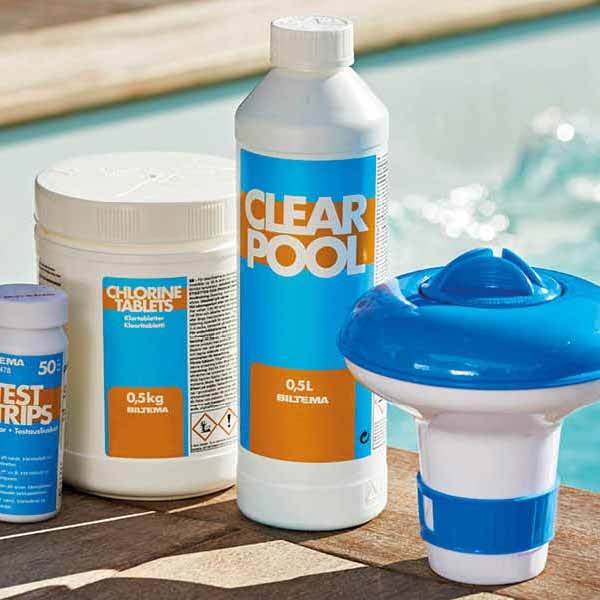
TEST STRIPS are available in Biltema's product range. They are also included in the POOL STARTER KIT.
Step 1 - pH Adjustment
The ideal pH level is between 7.0 and 7.4.
The water's pH level is crucial to pool care because it affects both water balance and disinfection. The first and most important step is therefore to test the pH level. The water should be between 7.0 and 7.4.
If the pH level is too high, skin and eyes may become irritated while the effectiveness of the disinfectant decreases.
If the pH level is too low, the disinfectant becomes harsh on both the pool and its users.
Our product range includes pH treatments for both raising and lowering your pH level.
Poor water quality can have the following consequences:
- Severe stomach illness and nausea
- Itching and skin rashes
- Cloudy water and organic growth
- Heavy wear on the liner
- Premature wear of the pool pump
Step 2 – Disinfection
A pool should be a pleasant and safe place to relax. This requires clear, hygienic water. Pool water is constantly exposed to small particles, dirt, spores, and bacteria. Because bacteria multiply quickly, chlorine is needed to disinfect the water and prevent bacterial growth. Chlorine must be added continuously, and the amount required depends entirely on the water temperature and how dirty the water is.
The warmer the weather and the stronger the sun, the more chlorine your pool needs. The same applies to pool use: the more the pool is used and the more people swim in it, the more the water is contaminated by leaves, grass, suntan oil, skin cream, hair, and other substances that enter the water.
When you fill the pool with water, or when you have problems with water quality, you need to shock-treat the water. Shock treatment uses a higher dose of disinfectant for deep disinfection that kills organic growth and clears other contaminants from the water. Two days after shock chlorination, make sure the chlorine level is within the ideal range.
Regular shock treatment is also recommended, especially in hot weather, after heavy rain, or when the pool is used heavily.
How Much Chlorine Should You Have in Your Pool?
To keep pool water clean and hygienic, the chlorine level should normally be between 1.0 and 3.0 mg/L (ppm). A chlorine level within this range helps prevent bacteria, organic growth, and other contaminants while keeping the water pleasant for swimming.
Keep the following in mind:
- Daily chlorine level:0 to 3.0 ppm.
- During heavy use: If many people are swimming, after heavy rain, or during hot weather, more chlorine may be needed to maintain the correct level.
- Shock chlorination: If the water is cloudy or there are algae problems, a temporary increase to approximately 5–10 ppm may be needed, according to the product instructions.
- Check the pH level: For best results, the pH level should be between 2 and 7.6. If the pH level is too high or too low, the chlorine will be less effective.
Because the size of the pool affects how much chlorine should be added, it is important to follow the dosing instructions on the chlorine product. As a guideline, one 200 g slow-dissolving chlorine tablet is often sufficient for approximately 20–30 m³ of water for one week, but the dosage varies between products.
Step 3 – Make the Water Crystal Clear
Water that is pleasant to swim in should be crystal clear. To ensure this, use a product in our range called Clear Pool, which helps produce crystal-clear water. The clarifier comes in liquid form and is diluted in a bucket of water before being poured into the pool.
Step 4 – Flocculation
Cloudy pool water is caused by dirt particles suspended in the water that are too small to be captured by the pool's sand filter. If steps 1 through 3 have not cleared the water, a flocculant should be used. The flocculant binds the small dirt particles into larger “flocs” that are then captured by the sand filter or sink to the bottom and are vacuumed up. The result is crystal-clear water.
Flocculant can be used both regularly and preventively. In pools with a filter cartridge (paper filter), flocculant should be used sparingly to avoid clogging the cartridge. It is recommended that the flocculated particles be allowed to sink to the bottom and then be removed with a pool-bottom vacuum.
Common Pool Problems – and How to Solve Them
In most cases, when you experience problems with pool water, you first need to test, check, and adjust the pH level. Because an incorrect pH level affects how chlorine works, it is important to ensure that the chlorine can work as intended.
Cloudy, Green Water and Slippery Walls
Slippery walls are usually caused by organic growth, which also makes the water cloudy.
If you suspect organic growth, do the following:
- Double-check that the pH level is within the ideal range of 7.0–7.4.
- Carry out shock chlorination. If the reading is 0 two days after shock chlorination, there is no free chlorine in the water.
- In that case, carry out another shock chlorination. If the walls are not slippery but the water is still cloudy or discolored, this may be due to metal or limescale deposits.
Strong Chlorine Odor
A strong chlorine odor is caused not by too much chlorine, but by too little free chlorine in the water. As chlorine is consumed, compounds known as chloramines form and give off the strong chlorine smell.
In this case, do the following:
- Double-check that the pH level is within the ideal range of 7.0–7.4.
- Carry out shock chlorination and, two days later, make sure the chlorine level is within the ideal range of 1–1.5 ppm (mg/L).
- If the strong chlorine odor still persists, replace all or part of the water.
Metal Deposits
Cloudy water caused by iron particles, for example, can be treated with shock chlorination and flocculation. The water will initially turn dark brown before the particles flocculate and are filtered out. Other minerals cannot be flocculated and need to be bound in another way.
Limescale and Limescale Deposits
If you live in an area with hard, lime-rich water, it is especially important to ensure that the pH level does not exceed 7.4. Limescale deposits may cause cloudy water and rough walls. If you suspect limescale in the water, check the pH level again. The easiest way to prevent future limescale deposits is to ensure that the pH level does not exceed 7.4.
Foaming Water
Personal care products and foaming cleaning agents are the most common causes of foaming water. It may also be caused by poor water quality and improper disinfection. To prevent too much personal care product from entering the water, showering before swimming is recommended. Never use household cleaning products, as they usually foam. To correct improper disinfection, check the pH level and carry out shock chlorination. If the water still foams, it needs to be replaced.
Corroded Metal Parts
Corrosion and rust are caused by a pH level that is too low. Adjust the pH level until it is within the ideal range of 7.0–7.4. Then make sure the pH level remains within this range.
Winterizing the Pool
The goal of winterizing is to protect the pool, pipes, pump, and filter from frost damage and make spring start-up easier.
How you should winterize your pool depends on the type of pool you have:
- Children's pools, steel-frame pools, and Fast Set pools must be cleaned, dried, and dismantled for indoor storage during the winter.
- Above-ground pools are normally drained to about half their water level.
- In-ground pools retain their water during the winter, while their skimmers, inlets, and pipes are drained and closed. The water level can also be lowered below these components to prevent frost damage. Drain the filter pump and store it in a frost-free location. Also cover the pool with a pool cover.
Steel-wall pools and other winter-resistant pools need to be prepared for winter by lowering the water level according to the manufacturer's recommendation, fitting the winter cover, draining the pump, filter, and pipes, and adding a winterizing treatment if needed.